
What is EPF registration?
EPF (Employee Provident Fund) Registration is a mandatory process by which an employer registers their business establishment with the Employees’ Provident Fund Organisation (EPFO) to provide retirement savings and social benefits for their salaried staff.
What it Means for Employers
- Mandatory compliance under EPF & MP ACT of 1952, any business with 20 or more employees is legally required for register.
- Once registered, Employer must deduct a specific portion (typically 12%) from an employee’s salary and contribute an amount for EPF accounts monthly.
What it Means for Employees
- Financial security ensuring a financial safety for employee when they retire.
- Registered employee are provided with a Universal Account Number (UAN) which is a single lifetime account that remains unchanged even if they switch jobs.
Is EPF Mandatory for Start-ups?
Startups and required to register for EPF if they reaches a headcount of 20 or more employee’s. For startups with fewer than 20 employees EPF is optional
If the startup has 10 or more employees (but under 20) with wages up to ₹21,000. Startup is required to provide ESI (Employees’ State Insurance) which covers medical benefits rather than retirement.
EPF registration Online process in India
EPF registration in India is eligible for companies with 20 or more employees. The process is free of cost and entirely online, completed through the Unified Shram Suvidha Portal (USSP).
Step-by-Step EPF Registration Process
- Go to the Unified Shram Suvidha Portal and click ”Sign up” as an employer.
- Log in, select “Registration for EPFO-ESIC,” and choose to apply for a new registration under the Employees’ Provident Fund and Miscellaneous Provision Act.
- Fill the form enter your business legal name, PAN, business nature, and employee counts.
- Submit scanned copies for your establishment’s Documents.
- Verify the application form using the employer’s Digital Signature Certificate (DSC).
- Upon successful verification (which takes 7-10 working days), the EPFO will issue a unique Establishment ID.
Documents Required for EPF Registration
- Business Docs: PAN card of the company, Certificate of incorporation, and adders proof (e.g, electricity bill or rent agreement.
- Authorized Person: PAN and Aadhaar of the employer or signatory.
- Banking: Bank statement matching the establishment’s name.
- Employee Data: list of employees, their joining dates, and their salaries.
EPF registration for companies with less than 20 employees
Under EPF & MP Act of 1952, EPF registration is not mandatory for companies fewer than 20 employees. However, employers can apply for voluntary registration if the majority of their employees agree and jointly apply with the employer to the central PF Commissioner.
EPF Contribution Rules
Under standard EPF rules, both the employee and employer contribute 12% each of the employee’s basic salary plus Dearness Allowance (DA) to the Employees’ Provident Fund. This applies to establishments with 20 or more employees where the employee’s basic wage is up to ₹15,000 per month.
Key Rules
- 12% Match: Employee and employer both contribute 12% of basic salary + DA.
- ₹15,000 Ceiling: Mandatory for employees earning up to ₹15,000 monthly basic wage.
- Employer Split: Employer’s 12% splits into EPF (3.67%) and EPS Pension (8.33%).
- Extra Fees: Employer pays an extra 0.5% for EDLI Insurance and 0.5% for admin charges.
- Voluntary VPF: Employees can voluntarily contribute more than 12% via VPF.
- 10% Reduction: Smaller firms (under 20 staff) can reduce contributions to 10%.
- 15th Deadline: Total monthly deposits must reach the EPFO by the 15th of the next month.
Benefits of EPF registration
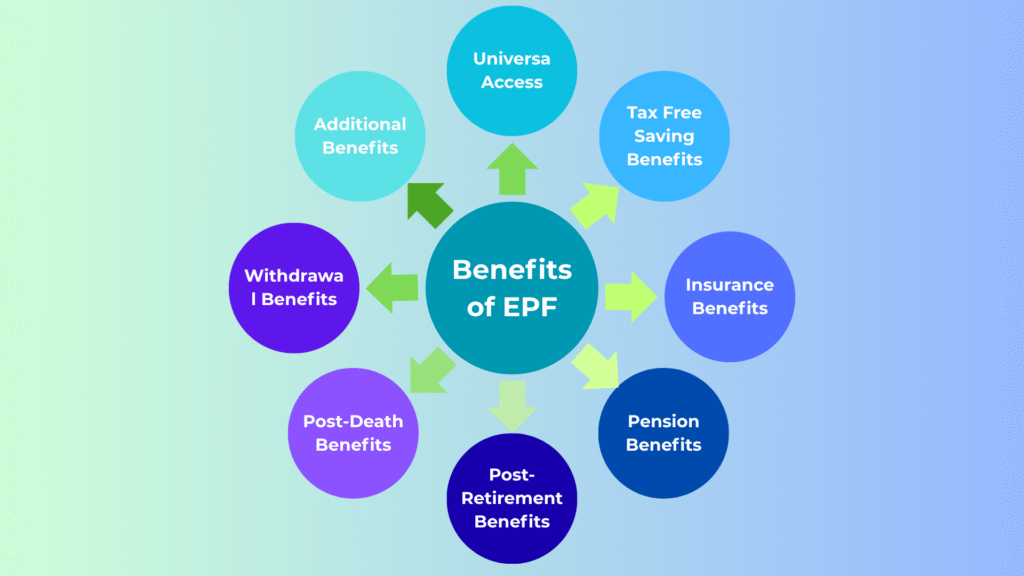
EPF registration provides a safe, government-backed savings plan for life after retirement. It helps employees save money automatically every month while offering strong tax benefits and emergency financial support.
Key Benefits
- Double Savings: Both you and your employer put 12% of your salary into this fund.
- Good Interest: Your money earns steady, government-guaranteed interest every year.
- Tax Savings: You save on income tax when you invest and when you withdraw.
- Monthly Pension: You get regular monthly payouts after retirement.
- Free Life Insurance: Dependents get up to ₹7 lakh if the employee passes away.
Common EPF Registration Mistakes
EPF registration errors can lead to immediate rejections, delayed withdrawals, or heavy financial penalties. Both employers and employees frequently make avoidable administrative slips during the setup process
Conclusion
EPF registration is more than just a legal requirement—it is a crucial step toward ensuring financial security for employees and maintaining statutory compliance for businesses. Whether you are a startup, MSME, or established organization, understanding EPF regulations and fulfilling your obligations on time can help avoid penalties while building trust among your workforce. By staying compliant and keeping accurate records, businesses can create a stronger, more secure future for both employers and employees.
Frequently Asked Questions
Q1. Is EPF registration mandatory for private limited companies?
Only if the company employs 20 or more people. Below that strength, it is optional.
Q2. Can a company with less than 20 employees register voluntarily?
Yes. A company can register voluntarily if both the employer and the majority of employees agree to it.
Q3. How long does EPF registration take?
The online process usually takes 1 to 3 working days after you submit all the correct documents.
Q4. What is the EPF contribution rate?
The standard rate is 12% of the employee’s basic salary from the employee and 12% from the employer.
Q5. Is there any government fee for EPF registration?
No. Registering your establishment on the official EPFO portal is completely free of cost
Pingback: EPF VS ESIC Which Benefits Matter Most For Employees? - epfesic.com